
Businesses send staff abroad, pay VAT on hotels, conference fees and taxis, and often never ask for it back. How much unclaimed VAT is there? Nobody measures it directly, so this study builds the answer from official statistics: how much foreign business travellers spent in Europe, how much VAT that spending carried, and how much of it the rules allow a foreign business to recover.
Table of Contents
Key Findings
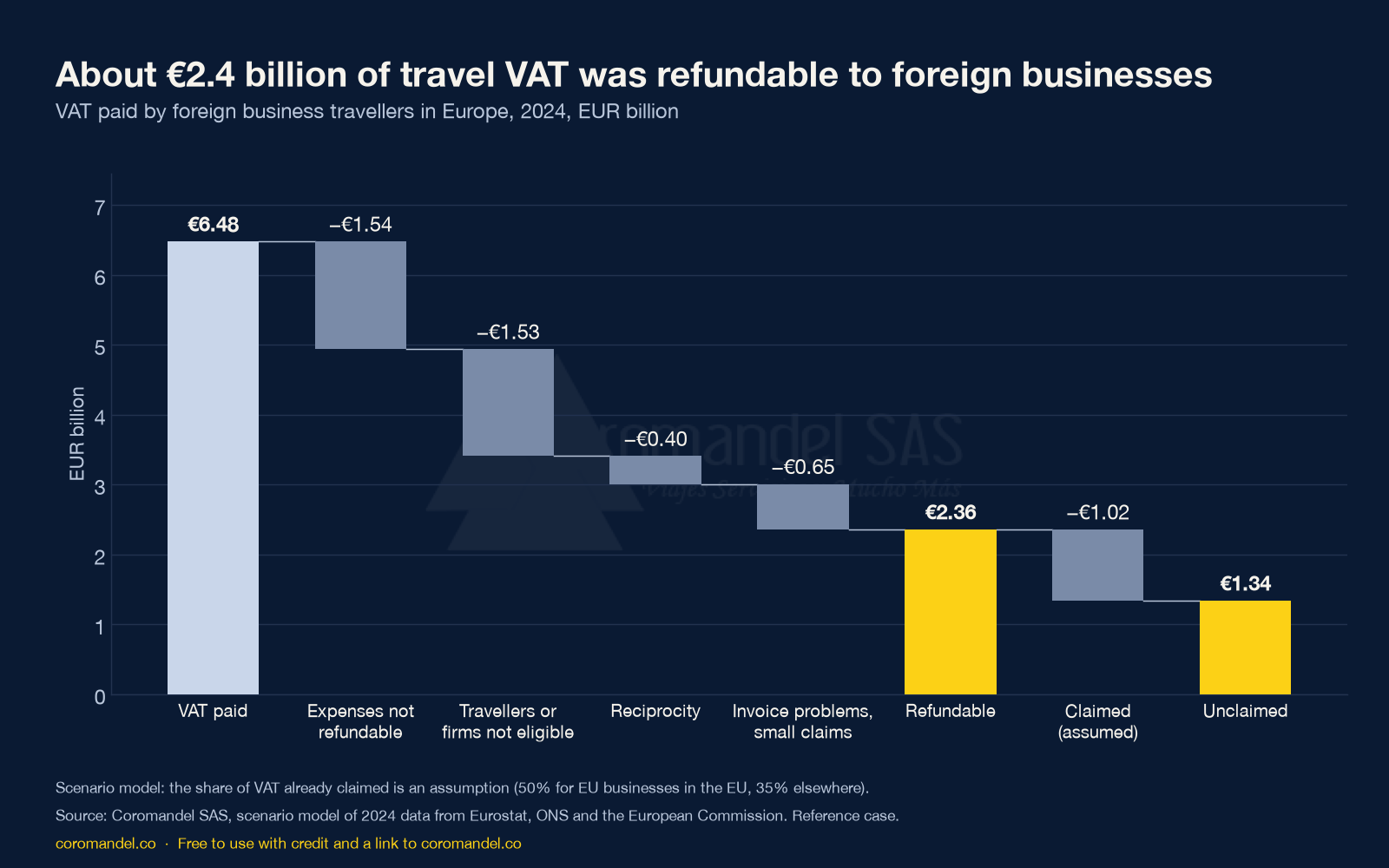
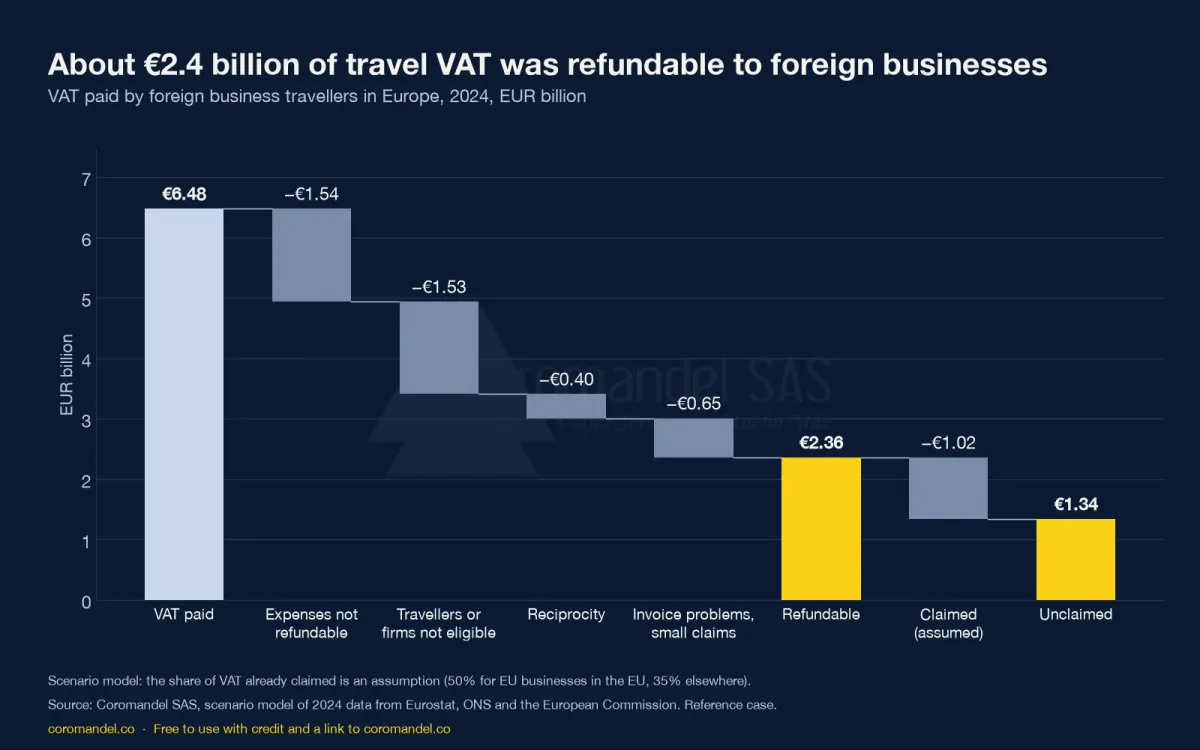
- Foreign businesses could have recovered about €2.4 billion (US$2.6 billion) of VAT on business travel in Europe in 2024. That is VAT on valid invoices, after the expenses countries refuse to refund, reciprocity rules and paperwork problems.
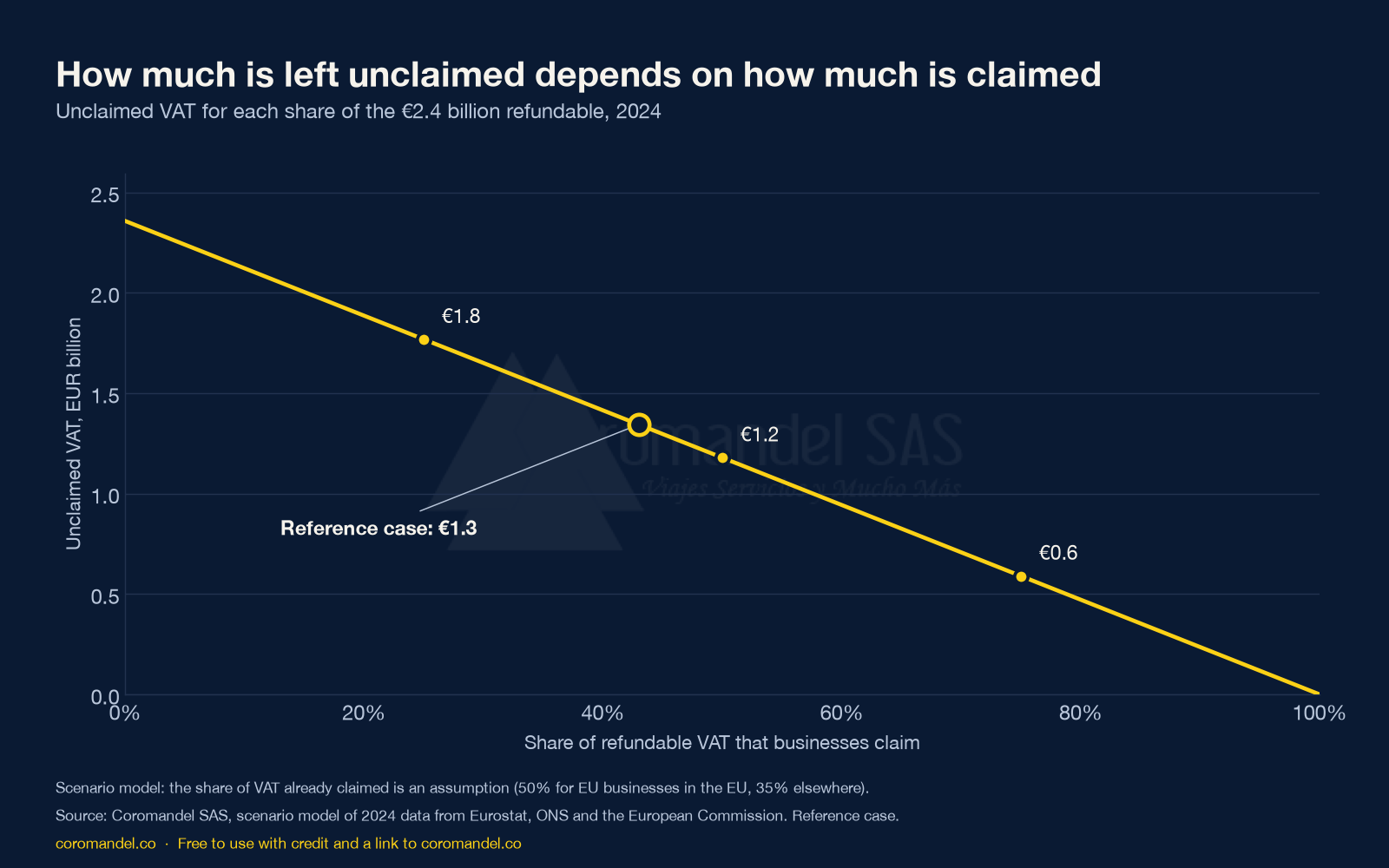
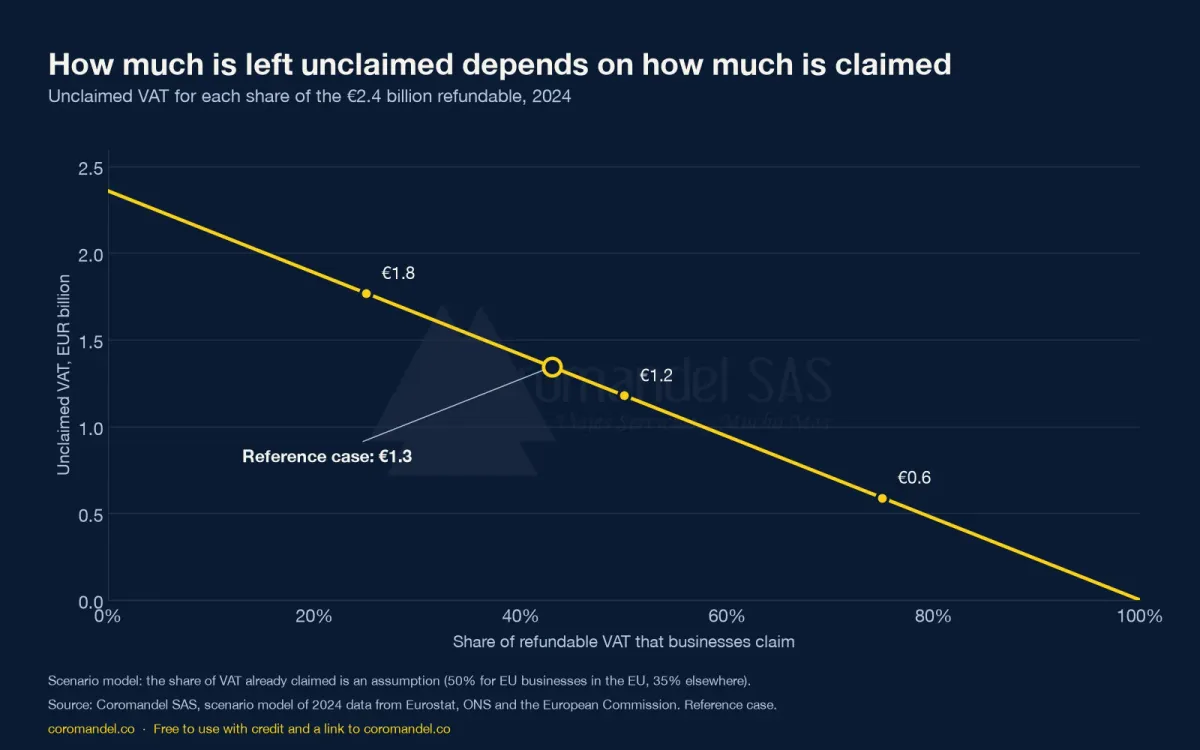
- How much of it went unclaimed depends on how much businesses claim, which nobody measures. If EU businesses claimed half of what they could recover in other EU countries, and businesses claimed about a third everywhere else, about €1.3 billion (US$1.5 billion) was left unclaimed.
- Under other reasonable assumptions, the unclaimed amount ranges from about €0.6 billion to €2.6 billion.
- €1.1 billion (US$1.2 billion) of the refundable VAT has to be claimed country by country, under each country’s own rules: by businesses from outside the EU, and by EU businesses claiming in the United Kingdom, Norway, Switzerland or Iceland. If businesses claimed about a third of it, about €0.7 billion (US$0.8 billion) was left unclaimed. The rest is claimed by EU businesses in other EU countries, through their own tax authority’s online portal.
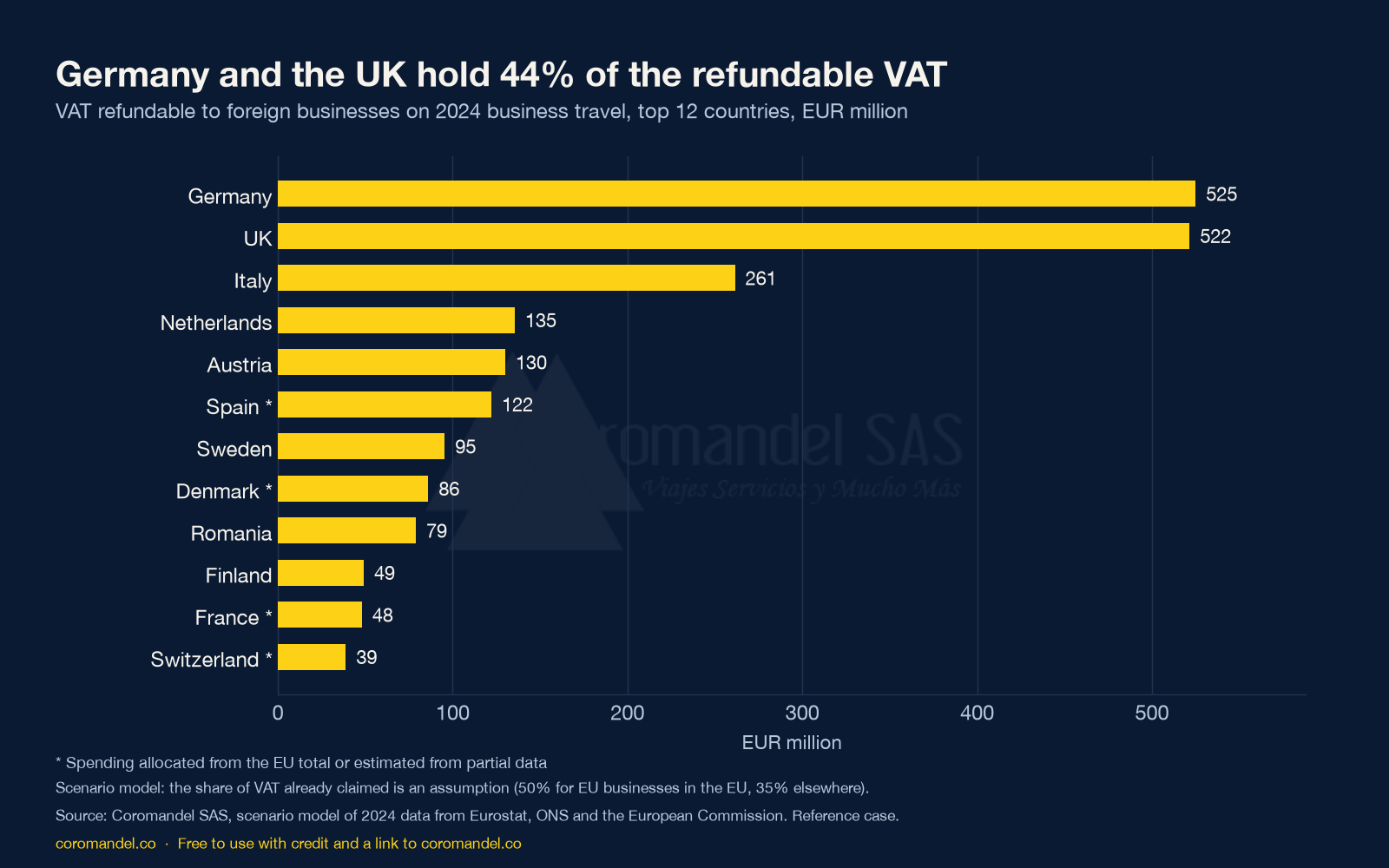
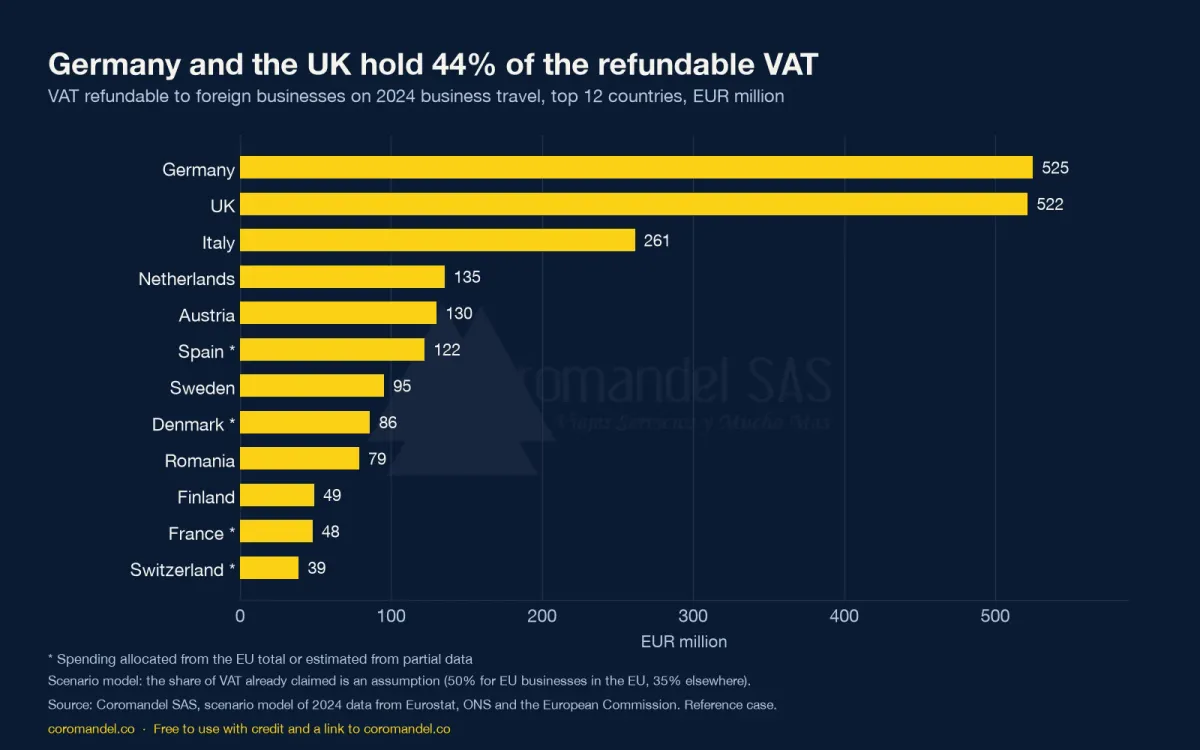
- Germany and the UK hold 44% of the refundable VAT (€525 million and €522 million), followed by Italy (€261 million).
- US businesses could have recovered about US$240 million of VAT on their business travel in Europe. More than three quarters of it (77%) is in the UK and Germany.
- On the same €1,000 of business-trip spending, a foreign business can recover about €139 of VAT in the UK but only €25 in Ireland, where hotels and meals are excluded.
- Of the €6.5 billion of VAT that foreign business travellers paid, almost two thirds could not be refunded at all, because of country rules, reciprocity, who was travelling and missing paperwork.
About €2.4 billion of VAT on 2024 business travel in Europe was refundable to foreign businesses. At the reference claim rates, about €1.3 billion was left unclaimed.
How Much VAT Could Foreign Businesses Recover?
The study follows the money from what foreign business travellers spent to what their companies could claim back.
| Step | EUR Billion, 2024 | What Happens at This Step |
|---|---|---|
| Spending inside European countries by foreign business travellers | 58.54 | Official balance-of-payments statistics |
| VAT inside that spending | 6.48 | Country VAT rates for hotels, meals, transport and other costs |
| Minus expenses countries don't refund | −1.54 | For example meals, entertainment, staff transport in some countries |
| Minus travellers or businesses not entitled | −1.53 | Personal purchases, public-sector travellers, firms without full VAT deduction rights |
| Minus reciprocity | −0.40 | Countries that refuse claimants from certain countries |
| Minus invoice problems and small claims | −0.65 | Invoices not in the company's name, missing VAT numbers, claims below minimums |
| Refundable | 2.36 | Valid VAT a foreign business could claim |
What Foreign Business Travellers Spent
National statistics offices record what business visitors from abroad spend inside their country, in the balance of payments. It covers hotels, meals, local transport and other purchases during a trip, and excludes international fares. In 2024, business visitors spent €49.2 billion inside EU countries, of which €29.2 billion came from other EU countries and €3.8 billion from the United States. Business visitors to the UK spent £5.9 billion (€6.9 billion). With Norway, Switzerland and Iceland, the total is €58.5 billion.
The VAT Inside the Spending
Hotels take the largest share of what business travellers spend at their destination, and they are usually taxed at a reduced rate: 7% in Germany, 10% in France, Italy and Spain, 20% in the UK. VAT is added to the net price, so at a 20% rate it is one sixth of the bill, not a fifth. Across Europe, VAT made up about €6.5 billion, or 11% of the spending.
What Can’t Be Refunded
Most of that VAT could not be claimed back by a foreign business:
- Country rules exclude some expenses. Norway refuses VAT on food and drink, France on ordinary passenger transport for staff, and many countries on entertainment.
- Not every traveller or business qualifies. Personal purchases on a business trip, public-sector travellers and businesses in VAT-exempt sectors such as banking and insurance can’t reclaim it.
- Reciprocity. Some countries refund only businesses from countries that would refund theirs. Germany’s official list includes the United States but not Colombia. Spain applies reciprocity too, but waives it for qualifying trade-fair and congress costs. In the reference case, reciprocity blocks 23% of the VAT that US businesses could otherwise recover, and 29% for businesses from other countries outside the EU.
- Paperwork. An invoice made out to the employee, a card slip instead of a VAT invoice or a claim below the country’s minimum can’t be used.
A Colombian company can't recover the VAT on hotel stays anywhere in Germany: Germany refunds only businesses from countries on its reciprocity list, and Colombia isn't on it.
How Much Goes Unclaimed
Tax authorities publish how much they refund, but not how much businesses could have claimed. So the unclaimed amount depends on one number nobody measures: the share of refundable VAT that businesses actually claim.
| If Businesses Claim… | Unclaimed VAT, 2024 |
|---|---|
| 25% of what they could | €1.8 billion |
| 50% of what they could | €1.2 billion |
| 75% of what they could | €0.6 billion |
| Reference case: 50% for EU businesses in the EU, 35% for the rest | €1.3 billion |
The reference case assumes EU businesses claim more, because they file through their own tax authority’s online portal. Businesses from outside the EU, or claiming in the UK, Norway or Switzerland, face a different process, deadline and set of documents in each country.
Where the Refundable VAT Is
Germany and the UK hold more than 40% of the refundable VAT. Both attract large numbers of foreign business travellers and refund hotel VAT. For businesses from outside the EU, the UK matters most: it holds 37% of the VAT they can recover.
Our country guides explain what is refundable in each: United Kingdom, Netherlands, Austria, Sweden and Norway.
What €1,000 of Trip Spending Can Recover
The same €1,000 spent on a business trip carries different amounts of VAT in each country, and the rules let a foreign business recover very different shares of it.
| Country | VAT Paid | VAT a Foreign Business Can Recover | Main Reason for the Difference |
|---|---|---|---|
| United Kingdom | €160 | €139 | Almost everything is refundable except business entertainment |
| Norway | €148 | €81 | No refund on food and drink |
| France | €101 | €39 | No refund on staff hotels or ordinary passenger transport |
| Ireland | €118 | €25 | No refund on hotels and meals, except for qualifying conferences |
Who the Refundable VAT Belongs To
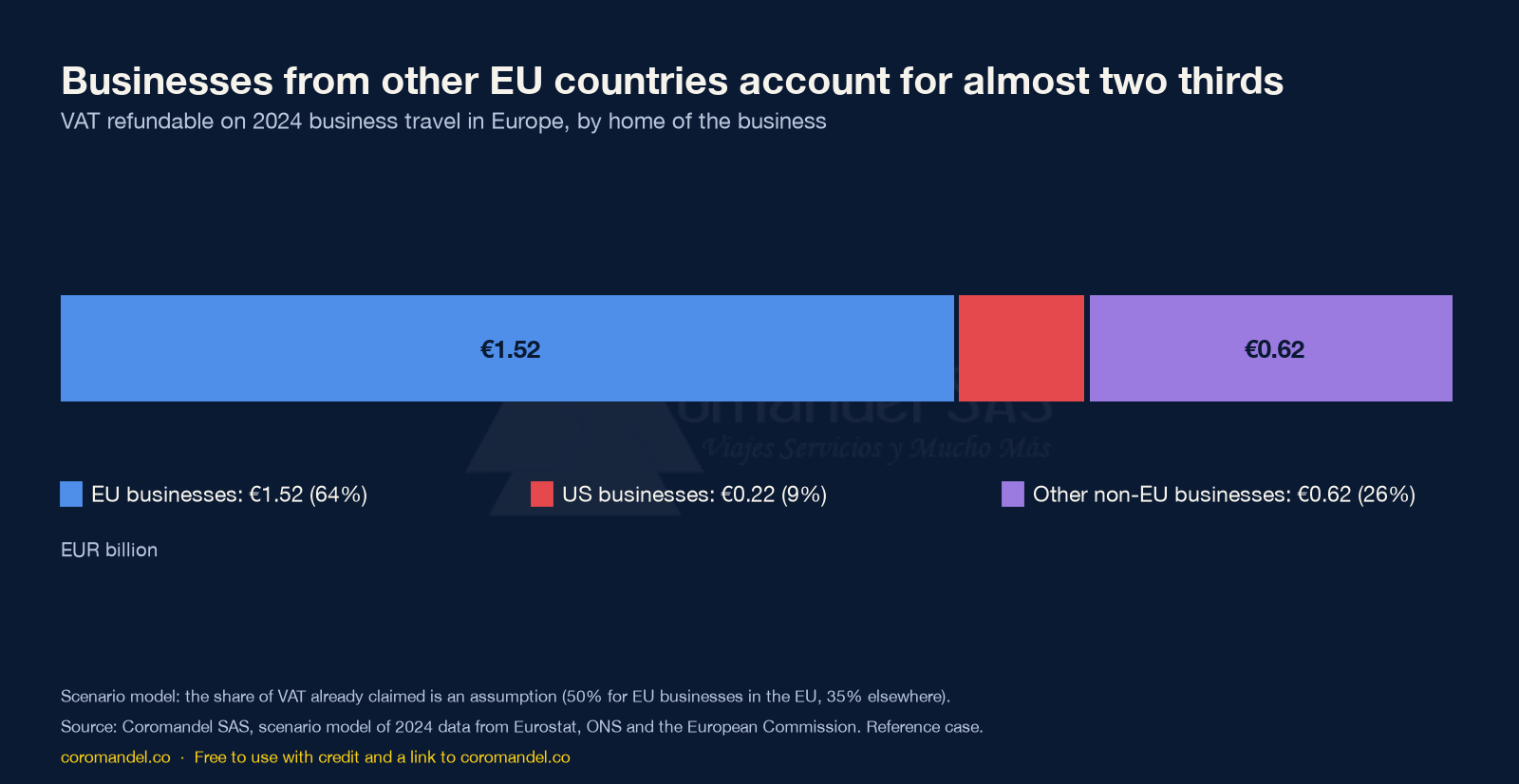
Businesses from other EU countries account for almost two thirds: €1.52 billion. They are the largest group of foreign business travellers in Europe. For claims in other EU countries, they use their own tax authority’s online portal, by 30 September of the following year. Claims outside the EU follow the destination’s national scheme.
US businesses could have recovered about €220 million (US$240 million). In the reference case, about US$160 million of it was left unclaimed. See foreign VAT recovery for US businesses.
Other businesses from outside the EU could have recovered €620 million. For businesses from countries such as Colombia, reciprocity decides where a claim is possible at all. See VAT recovery for Colombian companies.
Businesses from outside the EU, including US businesses, claim from each country separately, under that country’s rules, usually by 30 June of the following year. Just two countries, the UK and Germany, hold 53% of the VAT they can recover, so those are the places to start.
For US businesses, more than three quarters (77%) of the recoverable VAT is in the UK and Germany, and more than half (54%) in the UK alone.
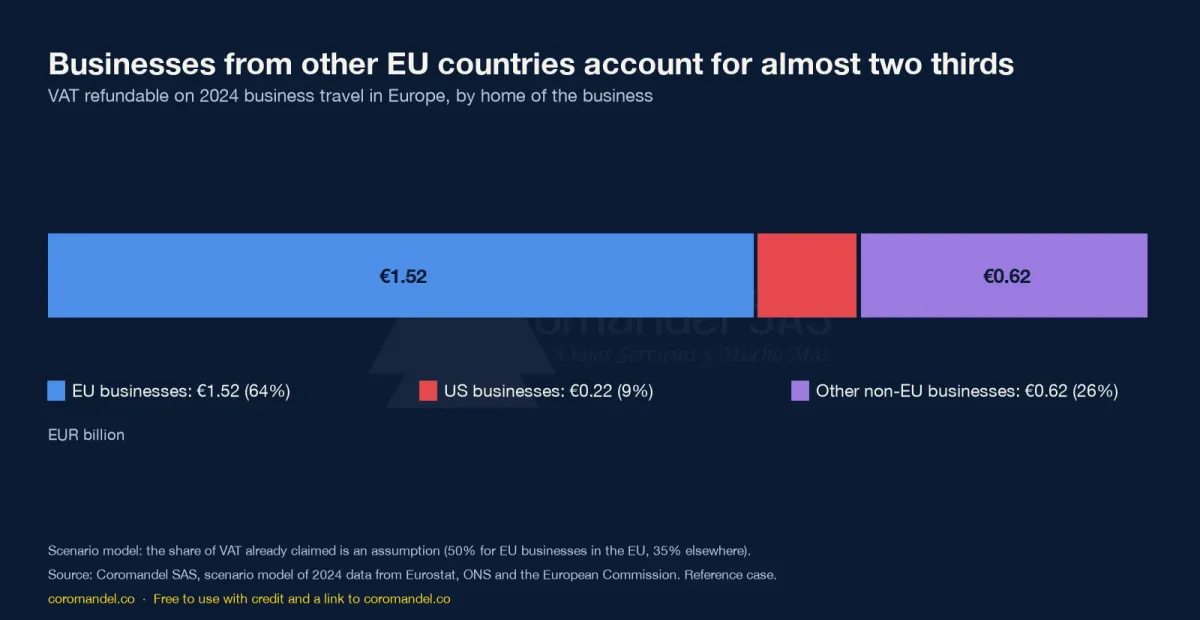
How much each group left unclaimed in the reference case:
| Businesses From | VAT Refundable, 2024 | Left Unclaimed (Reference Case) |
|---|---|---|
| EU countries | €1.52 billion | €0.80 billion |
| The United States | €0.22 billion (US$240 million) | €0.14 billion (US$160 million) |
| Other countries outside the EU | €0.62 billion | €0.40 billion |
| Total | €2.36 billion | €1.34 billion |
Why Companies Leave VAT Unclaimed
- Nobody owns it. Travel managers book the trip, finance pays the expense report, and nobody is responsible for the foreign VAT.
- Invoices in the wrong name. Hotel bills hold almost half (47%) of the VAT a foreign business can recover, yet a hotel bill made out to the employee, or a card slip instead of a VAT invoice, can’t be used.
- Different rules in every country. Forms, languages, excluded expenses and minimum amounts all differ.
- Fixed deadlines. Businesses from outside the EU usually have until 30 June of the following year; EU businesses until 30 September. Once a deadline passes, the money is gone.
- The assumption that it can’t be done. Many companies outside Europe don’t know that their business qualifies.
Hotel bills hold almost half (47%) of the VAT a foreign business can recover. A hotel bill in the employee's name loses that VAT.
What to Do Before the Next Deadline
- Find out what you paid. Pull last year’s foreign hotel, conference and event costs by country. Our VAT refund calculator gives a quick estimate.
- Check the invoices, starting with hotel bills. Each should be in the company’s name and show the supplier’s VAT number.
- Check which countries refund your business. Reciprocity and excluded expenses decide what is worth claiming.
- File before the deadline, or ask a specialist to do it. The UK’s claim year runs from July to June, with claims due by 31 December, so it is often still open after the EU deadlines have passed. Coromandel SAS offers a free VAT recovery assessment and works on a contingency fee: no refund, no fee.
Methodology and Sources
What is measured and what is assumed. The spending base comes from official statistics. The VAT rates and refund rules come from national tax authorities and the European Commission. Who qualifies, how many invoices fail and, above all, how much businesses already claim are assumptions, because no public data measures them. The figures are therefore a model with a stated reference case, not a count. The low and high figures (€0.6 and €2.6 billion unclaimed) change these assumptions together; they are illustrations, not a statistical range.
Scope. VAT on business travel paid by businesses in a European country where they are not established: the EU-27, the United Kingdom, Norway, Switzerland and Iceland, 2024 data. UK spending covers Great Britain: Northern Ireland isn’t in the ONS source used. Not included: other refunding countries such as Japan and South Korea, and non-travel expenses such as supplier invoices.
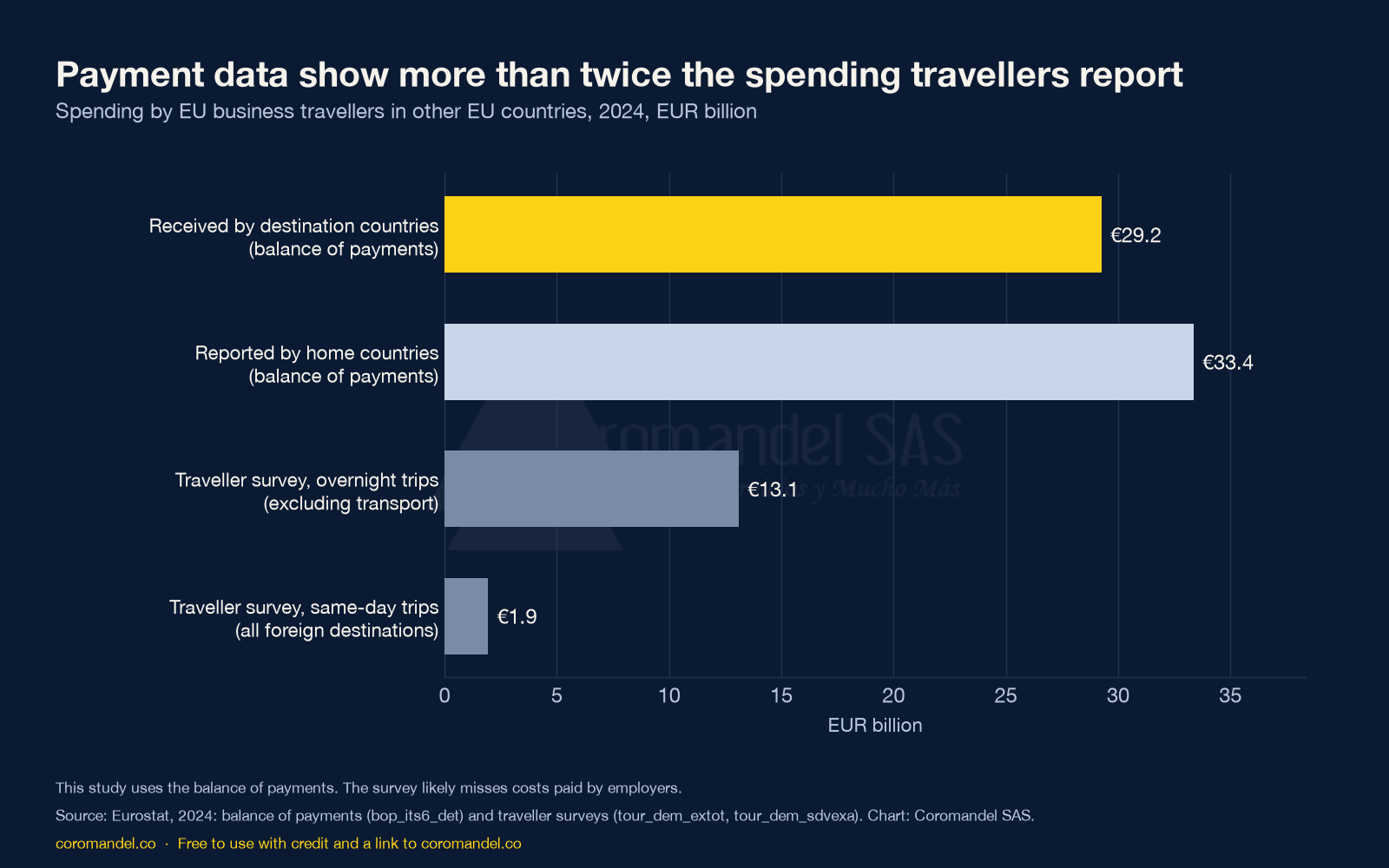
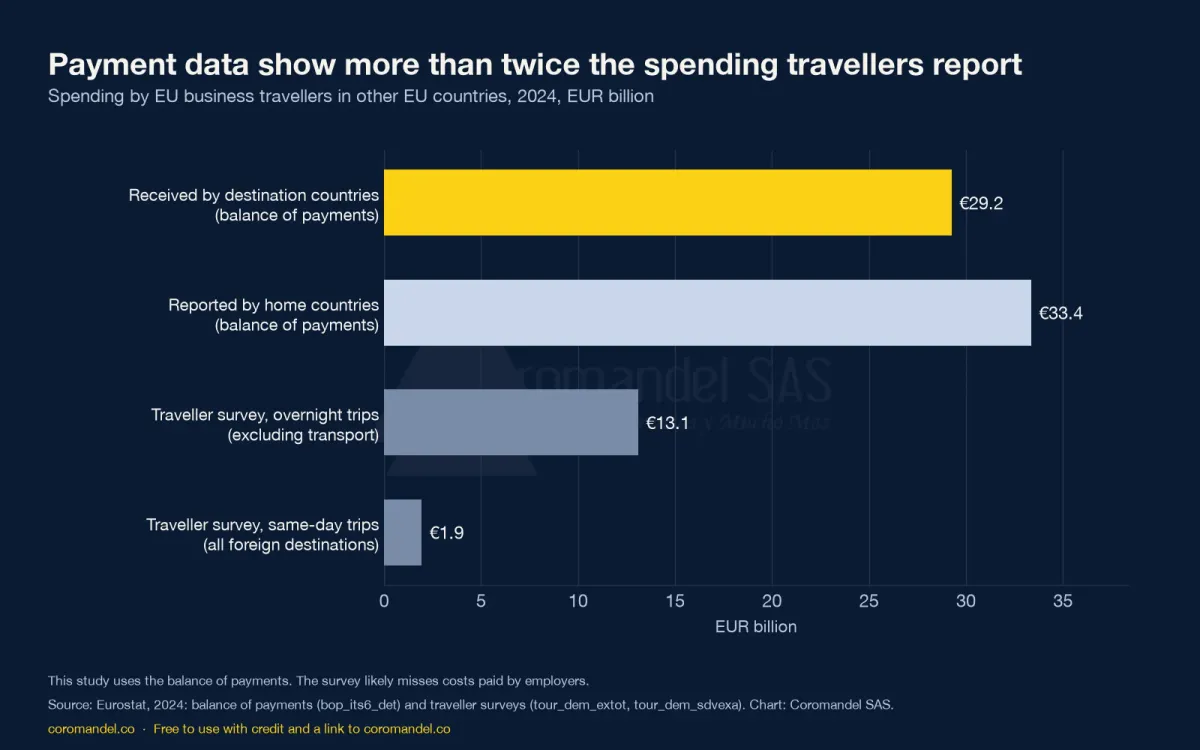
The spending base. The balance of payments measures business travel within the EU from both ends, and the two figures are close: destination countries recorded €29.2 billion received from EU business visitors, and home countries recorded €33.4 billion spent by their business travellers. Eurostat’s traveller survey shows much less (€13.1 billion for overnight trips), probably because travellers don’t report costs their employer pays. The study uses the balance of payments.
Sources.
- Spending: Eurostat, international trade in services by partner (travel, business, excluding seasonal and border workers), 2024. Spain, France, Denmark and Portugal don’t publish this split; their share of the EU total is allocated. United Kingdom: ONS, Travel Trends 2024 (business visits to Great Britain). Norway and Switzerland are estimated from partial data: Norway from its total travel receipts and the EU’s business share, Switzerland from its business travel receipts from outside the EU, scaled up in the same proportion as the EU’s. Both use the EU’s mix of origin countries.
- Spending mix: Eurostat, tourism expenditure by purpose and category, business trips abroad, 2024.
- Comparison of spending sources: the same balance-of-payments table (receipts and payments), and Eurostat’s traveller surveys for overnight trips and same-day visits, 2024.
- VAT rates in force in 2024: the European Commission’s Taxes in Europe Database for EU countries, and national tax authorities for the UK, Norway, Switzerland, Iceland and where the database is incomplete.
- Refund rules and reciprocity: national tax authorities, including Norway, Spain, Germany and the UK, the OECD’s Consumption Tax Trends 2024 (refund rules for foreign businesses, country by country) and the European Commission’s study of VAT refunds. Some origin-specific rules and the spending mix of eligible non-EU countries remain assumptions.
- Exchange rates: European Central Bank, 2024 annual averages (US$1.0824 and £0.84662 per euro).
Review. An independent reviewer audited an earlier version of this study and checked the 2024 reciprocity rules of all 31 countries. This version addresses the review’s findings; the remaining limitations are those listed above.
Use. The figures and charts are free to use with credit to Coromandel SAS and a link to this page. Full-size charts: refundable VAT, unclaimed by claim rate, by country, by home of the business, spending sources.