


Table of Contents
1 The VAT on 2025 Business Travel Left on the Table
Your company paid for business travel to Europe. How much of the recoverable VAT came back?
Across 31 European destinations, our model puts €823 million of VAT on 2025 business travel within reach of businesses based outside the European Union. If they submitted only half, €412 million may remain unclaimed. At assumed submission rates of 35% to 65%, the gap is €288 million to €535 million—about US$326 million to US$605 million at the 2025 average exchange rate. These filing rates are assumptions, and the dollar figures are currency equivalents, not a separate estimate for United States companies. No authority publishes the unclaimed total. [1, 2]
We measure VAT incurred on 2025 invoices, not refunds paid in 2025. The United Kingdom uses July-to-June refund years. Claims for its July–December 2025 invoices can still be filed until 31 December 2026. That part of the estimate remains at risk of going unclaimed; it is not yet a final loss. [3]
We cover all 27 European Union (EU) member states, plus the United Kingdom (UK), Norway, Switzerland and Iceland. Our focus is businesses based outside the EU, including the UK, the United States (US), the Gulf and Colombia.
The 13th Directive is the EU’s legal framework for VAT refunds to businesses established outside the EU. Eligible companies can reclaim VAT on business expenses incurred in member states. Claims go to the country where the VAT was charged. Local rules determine eligible expenses and required documents. Some countries apply the Rule of Reciprocity, requiring the company’s home country to offer similar refund rights in return. The other four destinations apply their own national schemes. [3, 4, 5, 6, 7, 8]
Including intra-EU claims does not erase the difference. Our 2024 model covered all claimant origins. Its reference case put refundable VAT at €2.36 billion and unclaimed VAT at €1.34 billion (about US$1.5 billion). The years differ, and both studies rely on unmeasured filing assumptions. Industry headlines can cover wider markets: VAT IT cites US$7 billion across foreign travel, entertainment and supplier invoices. VAT4U’s founder estimated more than €10 billion in unclaimed foreign VAT worldwide in 2018. VAT4U handles claims for businesses based both inside and outside the EU. Neither figure isolates VAT on 2025 business travel to our 31 destinations. [1, 9, 10, 11, 12]
2025 Spending by Inbound Business Travellers
These figures describe what business visitors from abroad spent inside each destination in 2025, across all traveller origins. They are travel-spending benchmarks, not VAT or refundable VAT. They do not measure the full cost of a trip, such as international fares. Each source uses its own reporting definition.
| Market | 2025 Inbound Business Visitor Spend | What It Measures |
|---|---|---|
| Denmark [13] | 11.02 billion kroner | Estimated spending by foreign business visitors |
| Finland [14] | €837.1 million | Sum of monthly inbound business spending estimates |
| Germany [9, 15] | €10.4 billion | Coromandel estimate of inbound business travel receipts, excluding international fares |
| Great Britain [16] | £5.61 billion | Spending on inbound business visits |
| Italy [17] | €6.30 billion | Inbound business and professional travel spending |
| Netherlands [18] | €6.6 billion | Business travel service exports |
| Spain [19] | €7.20 billion | Inbound business and professional travel spending |
Note: Red values are estimates or derived sums; black values are published totals. The measures and currencies differ, so the figures cannot be added together or used to rank refund potential. To assess a claim, you need the VAT shown on the invoices and the rules that apply to the company that paid it.
2 Where Your Company Travels Matters
Start with the destinations where your company spends most. This 31-country view estimates recoverable VAT on 2025 business travel by businesses based outside the EU. Your invoices establish what your company can actually claim.
Amounts in € millions. Red figures are provisional estimates of business-travel VAT. The 2024 base is business-purpose travel spending. Six countries use business-purpose growth; 24 use general travel growth only as a proxy; Switzerland holds the 2024 level flat. Holiday spending is never added to the base. These are not tax-authority claim or payment records. [1, 9, 20, 21]
| Destination | Recoverable VAT on business travel | Unclaimed if 50% submitted | 2025 growth input |
|---|---|---|---|
| Austria | 31.0 | 15.5 | General travel growth proxy |
| Belgium | 5.3 | 2.7 | General travel growth proxy |
| Bulgaria | 16.4 | 8.2 | General travel growth proxy |
| Croatia | 4.2 | 2.1 | General travel growth proxy |
| Cyprus | 2.9 | 1.5 | General travel growth proxy |
| Czechia | 5.7 | 2.8 | General travel growth proxy |
| Denmark | 44.2 | 22.1 | General travel growth proxy |
| Estonia | 1.4 | 0.7 | General travel growth proxy |
| Finland | 13.7 | 6.9 | Business trend |
| France | 25.5 | 12.7 | General travel growth proxy |
| Germany | 126.9 | 63.5 | Business trend |
| Greece | 5.5 | 2.7 | General travel growth proxy |
| Hungary | 3.3 | 1.6 | General travel growth proxy |
| Iceland | 1.4 | 0.7 | General travel growth proxy |
| Ireland | 3.4 | 1.7 | General travel growth proxy |
| Italy | 34.5 | 17.3 | Business trend |
| Latvia | 1.4 | 0.7 | General travel growth proxy |
| Lithuania | 4.5 | 2.2 | General travel growth proxy |
| Luxembourg | 1.0 | 0.5 | General travel growth proxy |
| Malta | 2.6 | 1.3 | General travel growth proxy |
| Netherlands | 62.0 | 31.0 | Business trend |
| Norway | 15.6 | 7.8 | General travel growth proxy |
| Poland | 6.0 | 3.0 | General travel growth proxy |
| Portugal | 6.9 | 3.5 | General travel growth proxy |
| Romania | 16.9 | 8.5 | General travel growth proxy |
| Slovakia | 0.8 | 0.4 | General travel growth proxy |
| Slovenia | 0.6 | 0.3 | General travel growth proxy |
| Spain | 33.7 | 16.8 | Business trend |
| Sweden | 40.1 | 20.1 | General travel growth proxy |
| Switzerland | 12.3 | 6.1 | 2024 base held flat |
| United Kingdom¹ | 293.5 | 146.8 | Business trend |
¹ Great Britain is the United Kingdom travel-spending base. The model’s £251.5 million recoverable VAT becomes about €293.5 million at the European Central Bank’s 2025 average of £0.857 per €1. [1, 9, 22]
3 What Authorities Refunded in 2025
Our country estimates concern business travel. Published refund totals provide a separate check on scale, but they include other expenses and different claimants. They cannot directly confirm the unclaimed amount.
France illustrates why the two kinds of figure must stay apart. Its authority reports €2.1 billion refunded across many business expenses and EU and non-EU claimants. Our €25.5 million is a provisional estimate of recoverable VAT on 2025 business travel for non-EU claimants. It excludes employee hotel accommodation, which French rules generally bar from deduction. The model’s remaining French amount comes mainly from meals and other potentially eligible purchases; the claimant-origin split is imputed. Neither figure validates the other. [9, 23, 24]
Reported Payments and Authorisations
The figures below retain each authority’s currency and reporting scope. Black figures are published administrative amounts. Hungary reports authorisations; the other rows report refunds or repayments. None isolates non-EU business travel with matched claims and payments. [23, 25, 26, 27, 28, 29, 30, 31]
| Destination | 2025 Amount | What the Authority Reports |
|---|---|---|
| Czechia [29] | 4.7 billion Czech koruna | Refunds to non-established EU and non-EU businesses. Diplomatic and military refunds are separate. |
| France [23] | €2.1 billion | Refunds to businesses without economic activity in France; EU and non-EU scope. See note below. |
| Hungary [28] | 124.8 billion Hungarian forints | VAT authorised for non-established taxpayers; cash payment and EU/non-EU split not established. |
| Iceland [27] | 1.041 billion Icelandic krónur | VAT refunds to foreign parties across expense types. |
| Ireland [30] | €2.8 million | Repayments in the category “Foreign Traders Non-EU”; no travel-only breakdown. |
| Luxembourg [25] | €74.1 million | Non-resident office refunds across expense types and EU/non-EU claimant origins. |
| Norway [26] | 377.9 million Norwegian kroner | Cash VAT refunds to foreign companies across expense types. |
| Sweden [31] | 2.715 billion Swedish kronor | Combined refunds to foreign companies, embassies and others; business-only amount not isolated. |
Note: France’s 2025 report states €2.1 billion on page 5, but prints an inconsistent million-euro unit on page 19. We use page 5 and flag the discrepancy. The service also handles embassies and international organisations; their exclusion from the amount is not established. [23]
Refunds Paid Do Not Reveal What Was Never Claimed
France received 129,177 requests and processed 111,860 during 2025. Those are different annual flows. Dividing one by the other would not establish a payment or acceptance rate. Nor can the 93% EU share of incoming requests be used to split the money refunded. [23]
Luxembourg received 38,271 applications, but reports no monetary value submitted for the claims it paid. The missing comparison is eligible VAT against actual claims for the same expenses and period. A calendar-year travel total also spans two July-to-June refund years in the UK. [3, 25]
4 What the 2025 Estimate Shows
The central model puts recoverable VAT at €823 million. If 65% was submitted, €288 million would remain unclaimed. At 50%, the amount is €412 million. At 35%, it is €535 million. These are alternative filing assumptions, not three observed outcomes. [1]
The recoverable pool is uncertain too. Varying the archived eligibility case and allowing for the observed difference between business and all-travel trends produces €432 million to €1,349 million. That is a stress range, not a statistical confidence interval. It does not establish how much was actually submitted. [1, 9]
Where the Working Opportunity Is Largest
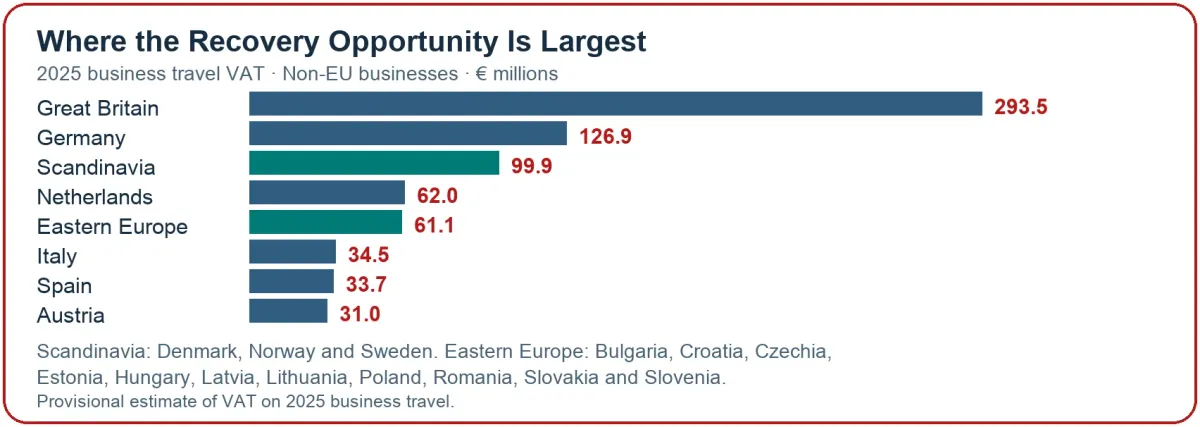
The chart shows the central recoverable pool, before any filing assumption. It draws on the archived eligibility model, six business-purpose trends and 24 all-travel proxies. Great Britain is the largest market for this non-EU claimant subset. [1, 9]
The Share Submitted Changes the Gap
The next chart assumes half the recoverable VAT was submitted. It illustrates the calculation, not the current filing rate. Published refund totals cannot supply a travel-only submission rate for the same population. [1]

| Assumed VAT Submitted | Working Recoverable VAT | Modelled Unclaimed |
|---|---|---|
| 65% | 823 | 288 |
| 50% | 823 | 412 |
| 35% | 823 | 535 |
All amounts are € millions, rounded. None of the filing rates is measured. This is VAT on 2025 expenses that may remain unclaimed after the applicable deadlines, not a count of claims rejected or a 2025 cash-refund figure. [1]
5 Why VAT Goes Unclaimed
The Expense Is Approved but the Invoice Is Missing
Hotel invoices are the first place we look. In Coromandel’s client work, roughly 75% to 80% of refunds we handle relate to hotel expenses. That is our experience, not a measured Europe-wide share or an input to the 2025 estimate. A hotel bill may be a sizeable claim in one country and ineligible in another, as France shows. [24]
Travel approval and VAT recovery are different controls. An employee may upload a phone photo to Concur or another Expense Management System. Finance can approve the cost, while the reclaim team still lacks a usable tax invoice. The employee’s name on the invoice need not defeat a claim. Austrian guidance permits it for certain domestic hotel expenses; foreign claimant rules still need checking. The company’s address matters where the destination requires the purchaser’s details. A wrong name or address, incorrect amount or tax calculation, or missing supplier VAT registration number can delay or defeat a refund. If nobody checks the invoice at expense approval, the problem may surface close to the filing deadline. [3, 32, 33, 34, 35, 36]
How We Obtained the Hotel Invoice
For the March 2026 stay, the client sent us the record from its travel reservations system. We contacted the UK hotel and received the invoice in October. It showed three nights at £458.33 each and £218.25 in VAT within the £1,374.99 total. With the invoice in hand, we could assess eligibility.
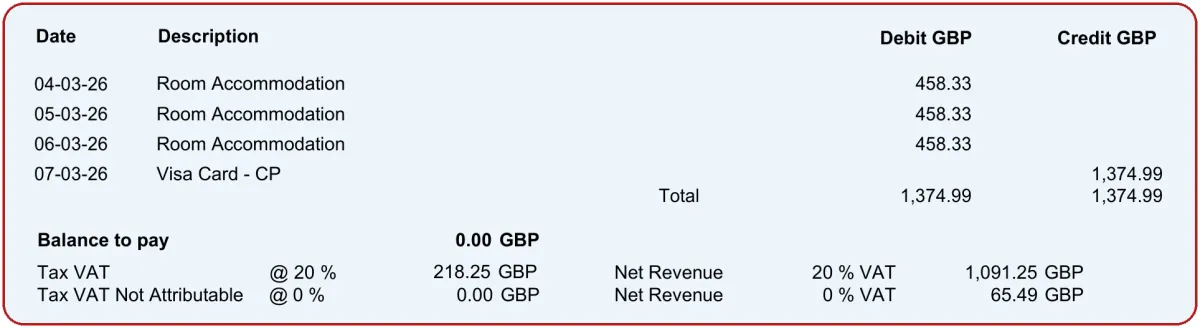
Actual UK hotel invoice dated 20 October 2026, showing £218.25 in VAT.
For UK claims, we can ask the hotel for a certified true copy of a missing or unreadable invoice. His Majesty’s Revenue and Customs (HMRC) has accepted these copies in claims we’ve handled. We seek post-trip supplier corrections in other countries only where their rules permit them. [3, 37, 38]
Different Rules Break a Single Recovery Process
Many finance teams do not know which overseas costs are refundable. Others assume the process is too complex to be worth the effort. A company can have valid invoices and still miss a claim. Expense eligibility, the Rule of Reciprocity, tax representatives, certificates of business status and filing methods differ by destination. France requires a local tax representative for businesses based outside the EU. Switzerland also requires a representative and a power of attorney for each application. The Organisation for Economic Co-operation and Development reports that supporting documents are a major administrative requirement for non-resident refunds. [4, 5, 6, 39]
Smaller amounts are easily left in travel expenses when no team owns the cross-border claim. Several modest hotel invoices across many countries can add up. Yet each destination may demand a separate review and submission. That is a probable cause of non-submission, not a measured share of our €412 million working case. [1, 39, 40]
VAT Is Budgeted as a Travel Cost
Businesses typically budget the gross hotel cost, including VAT, within travel expenses. Many then expense the full amount. Once the trip is closed, the recoverable tax is easy to overlook. A Travel Management Company (TMC) can change how the refund is seen: by identifying and reporting it as a travel saving, it gives finance a reason to follow the claim through. The refund turns a cost already in the travel budget into cash recovered. We have not measured how much of the 2025 gap this explains. [41]
A Deadline Turns Delay into Cost
A valid invoice still needs a timely claim. The UK claim year ended 30 June 2026 must normally be filed by 31 December 2026. Many EU destinations, including France, set 30 June after the calendar year for businesses based outside the EU. But the Thirteenth Directive lets each member state set its own time limit. Denmark allows until 30 September of the following year. The correct deadline must be checked for every destination. After it closes, eligible VAT may become a permanent expense. [3, 5, 36, 42]
6 Recover What Belongs to Your Business
The precise Europe-wide loss cannot be observed from public refund totals. Our estimate shows the scale that is at stake. The decisive figure for a chief financial officer is the VAT on the company’s own invoices that can still be claimed.
If recoverable VAT was booked as an expense, a successful claim reduces travel costs after fees. If it was recorded as a receivable, the refund releases cash. Either way, leaving an eligible claim unfiled gives up value the business has already paid for.
Start with your largest travel destinations. Test a sample of hotel and event invoices against the local rules and deadlines. Coromandel can check the documents, obtain acceptable replacements where possible, file the claims and follow them through. Our fee is due only when VAT is recovered. [43]
The VAT is already on the invoice. The question is whether it returns to your business.
Request a Free VAT Recovery Assessment
Method and Sources
The 2025 working estimate starts with business-purpose spending for the US and other non-EU origin groups in the archived 2024 model. Six destinations use business-purpose movements. Another 24 use 2024–25 general travel-receipt movements only as proxies for the change in business travel; their total receipts never become the spending base. Switzerland has a flat central business-travel movement. The 2024 model estimates VAT by expense type and local eligibility; filing rates are tested separately. No actual claim rate is inserted. [1, 9]
The 25 percentage-point allowance is a stress test, not an assumed one-year increase in business travel. In Italy, published business-travel spending fell about 20% from 2024 to 2025 while total travel receipts rose about 5%: a gap of almost 25 percentage points. We apply that largest observed difference to the low and high cases in proxy markets; the central case still uses each country’s recorded travel movement. The UK model uses the European Central Bank’s 2025 average sterling rate. The estimate remains sensitive to the archived claimant-origin and expense assumptions. [1, 17, 22]
We use national statistics offices, central banks and tourism surveys for business-purpose checks. Denmark’s published estimate combines spending by foreign business hotel visitors and business day visitors; it is a scale check, not a like-for-like 2024–25 growth pair. [13]
For Germany, we scale the archived €11.1 billion 2024 business-travel receipts by the change from 14.7 million to 13.8 million inbound business trips. The result is about €10.4 billion for 2025. It assumes spending per trip stayed flat. The spending base excludes international passenger fares; no VAT on airline tickets is added to the recovery estimate. [9, 15]
Eurostat compiles the all-travel series from national submissions. Tax authorities provide separate evidence on claims and payments. We compare figures only when claimant populations, expenses and periods match. We have asked HMRC for claim and repayment data, but that response is not needed to calculate this published working range. [1, 3, 20, 21]
[1] Coromandel 2025 working model and method record, updated 16 November 2026. The accompanying workbook contains country inputs, proxy labels, sensitivity calculations and source limitations.
[2] European Central Bank, 2025 annual-average United States dollar exchange rate: US$1.1300 per €1
[3] United Kingdom, HMRC VAT Notice 723A
[4] European Commission, 13th Directive refunds to non-EU businesses
[5] French tax authority, filing procedure for businesses based outside the EU
[6] Switzerland, Federal Tax Administration foreign company refunds
[7] Iceland, Skatturinn reimbursement of VAT
[8] Norway, Tax Administration VAT in and out of Norway
[9] Coromandel 2024 model, version 3.1, archived results and methodology. Country and aggregate values are calculated from the saved model output.
Published 2024 study and methodology
[10] VAT IT, foreign VAT left unclaimed across travel, entertainment and accounts-payable expenses
[11] Interview with VAT4U founder Damien Moras, estimate of unclaimed foreign VAT worldwide, 2018
[12] VAT4U, recovery under EU and non-EU refund routes
[13] VisitDenmark, tourism spending supplementary tables, table 1, page 6
[14] Visit Finland, December and year 2025 report, page 11, monthly business spending
[15] German Convention Bureau and German National Tourist Board, World Travel Monitor 2025
[16] Office for National Statistics (ONS), Travel Trends 2025, table 9
[17] Banca d’Italia, 2025 Survey on International Tourism, table 5
[18] Statistics Netherlands, Dutch Trade in Facts and Figures 2026, table 4.3.2
[19] Spain, National Statistics Institute, tourist expenditure survey, table 23995, annual 2025
[20] Eurostat, annual 2024 travel credits by destination, all purposes and origins
[21] Eurostat, provisional annual 2025 travel credits by destination, all purposes and origins
[22] European Central Bank, Economic Bulletin 2/2026, table 4.9, 2025 average pound sterling per euro
[25] Luxembourg VAT administration, 2025 activity report, non-resident refund office
[26] Norwegian Tax Administration, 2025 annual report, note 9, page 98
[27] Icelandic tax authority, 2025 annual report, page 22, chart 11
[28] Hungary, National Tax and Customs Administration, 2025 yearbook, page 23
[29] Czech Financial Administration, 2025 annual report, page 10
[30] Irish Revenue, VAT Payments and Returns 2025, table 12, page 24
[31] Swedish Tax Agency, 2025 annual report, page 203, accounts 9411 042–043
[32] Concur guidance on taking or uploading a receipt photo
[33] Concur guidance on certified digitisation of paper receipts
[34] Council Directive 2006/112/EC, Article 226, invoice details required for VAT purposes
[35] Austrian Federal Ministry of Finance, input tax on hotel expenses and employee invoices
[36] Danish Tax Agency, invoice requirements for refunds to businesses outside the EU
[37] HMRC VAT Traders’ Records Manual, duplicate invoices
[38] HMRC guidance on supplier corrections to invoices
[39] Organisation for Economic Co-operation and Development (OECD), review of non-resident VAT recovery
[40] Global Tax Reclaim case study on foreign VAT recovery
[41] BCD Travel, VAT reclaim service and travel-cost savings
[42] Council Directive 86/560/EEC, Article 3, national filing time limits
[43] Coromandel foreign VAT recovery, invoice validation and filing
[44] Eurostat international trade in services release timetable
Eurostat data browser for travel credits, dataset bop_its6_det