

Information reviewed on 17 November 2026. Image above: AI-generated illustration.
For many families, India is a place to which they return throughout their lives. There are parents to visit, weddings to attend, and children to introduce to a country that forms part of their story. A foreign passport can change the formalities of that journey. It need not weaken the connection.
The Overseas Citizen of India, or OCI, scheme makes that connection easier to maintain. It provides eligible foreign nationals with long-term access to India and certain additional benefits. Understanding it, however, takes more than reading a list of documents. Applicants need to know which route applies to them, what their papers must establish, and which costs continue after the first application.
Throughout this guide, an Indian mission means an Indian embassy, high commission, or consulate. The United Kingdom hosts the High Commission of India in London; Colombia hosts the Embassy of India in Bogotá. Local examples identify the office concerned because application arrangements differ.
Table of Contents
What is an OCI card?
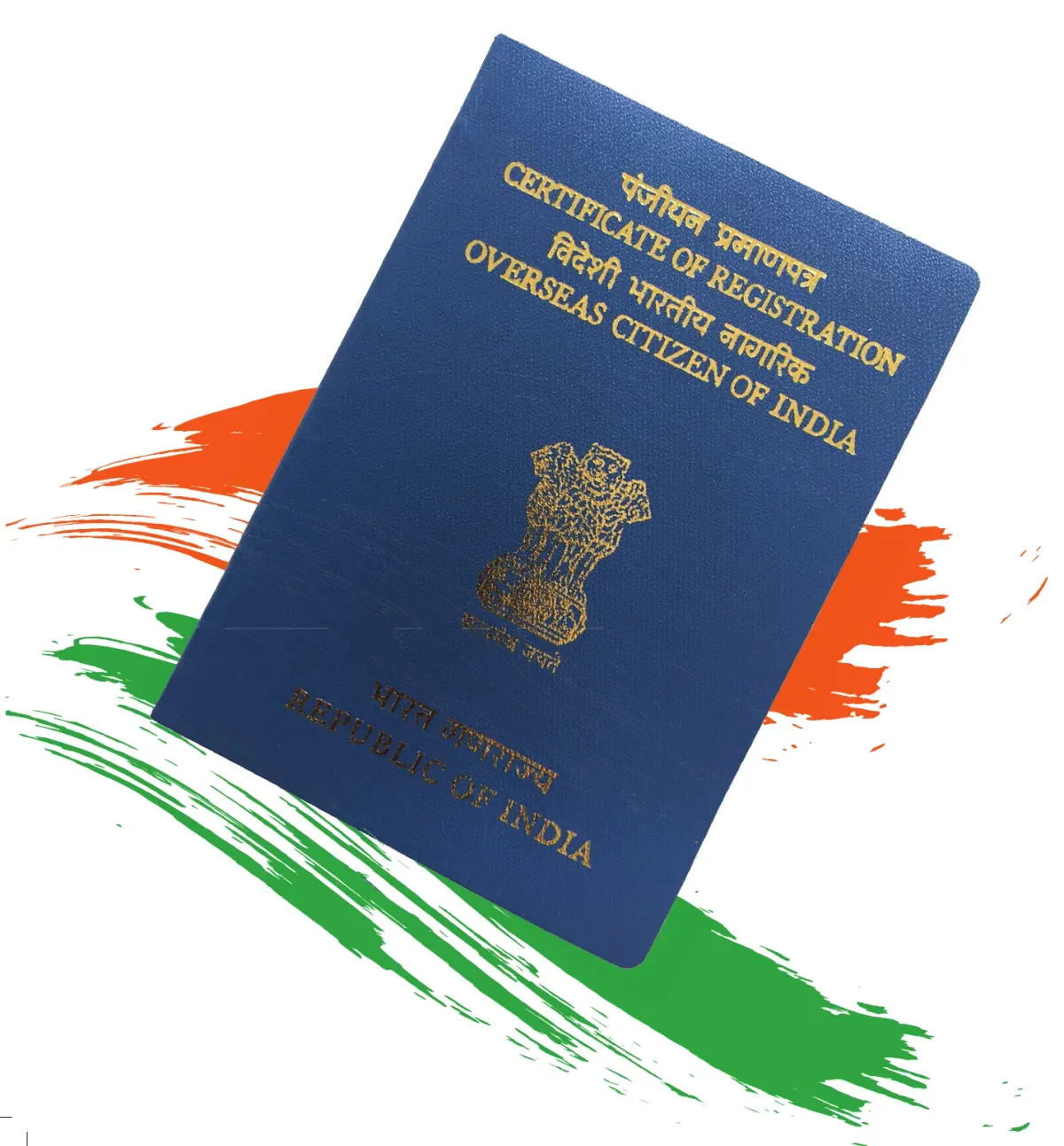
Despite its name, OCI is not Indian citizenship. It is a status available to qualifying foreign nationals. It does not provide an Indian passport, voting rights, or a general entitlement to Indian public employment. An Indian citizen living abroad does not need an OCI card simply because they live overseas. [1, 2]
The principal benefit is a multiple-entry, lifelong visa facility, subject to the applicable conditions. OCI holders are exempt from the usual foreigner-registration requirement for any length of stay. Certain activities, including research, journalism, missionary work, and visits to protected or restricted areas, still require permission. OCI also brings specified benefits concerning domestic airfares and admission charges at national monuments and other listed attractions. It does not give unrestricted property-purchase rights: agricultural land, farmhouses, and plantation properties are excluded from the purchase entitlement. [1]
For foreign-spouse applicants, the current central FAQ specifies five-year validity for the initial card. Confirm the subsequent procedure with the mission. [3]
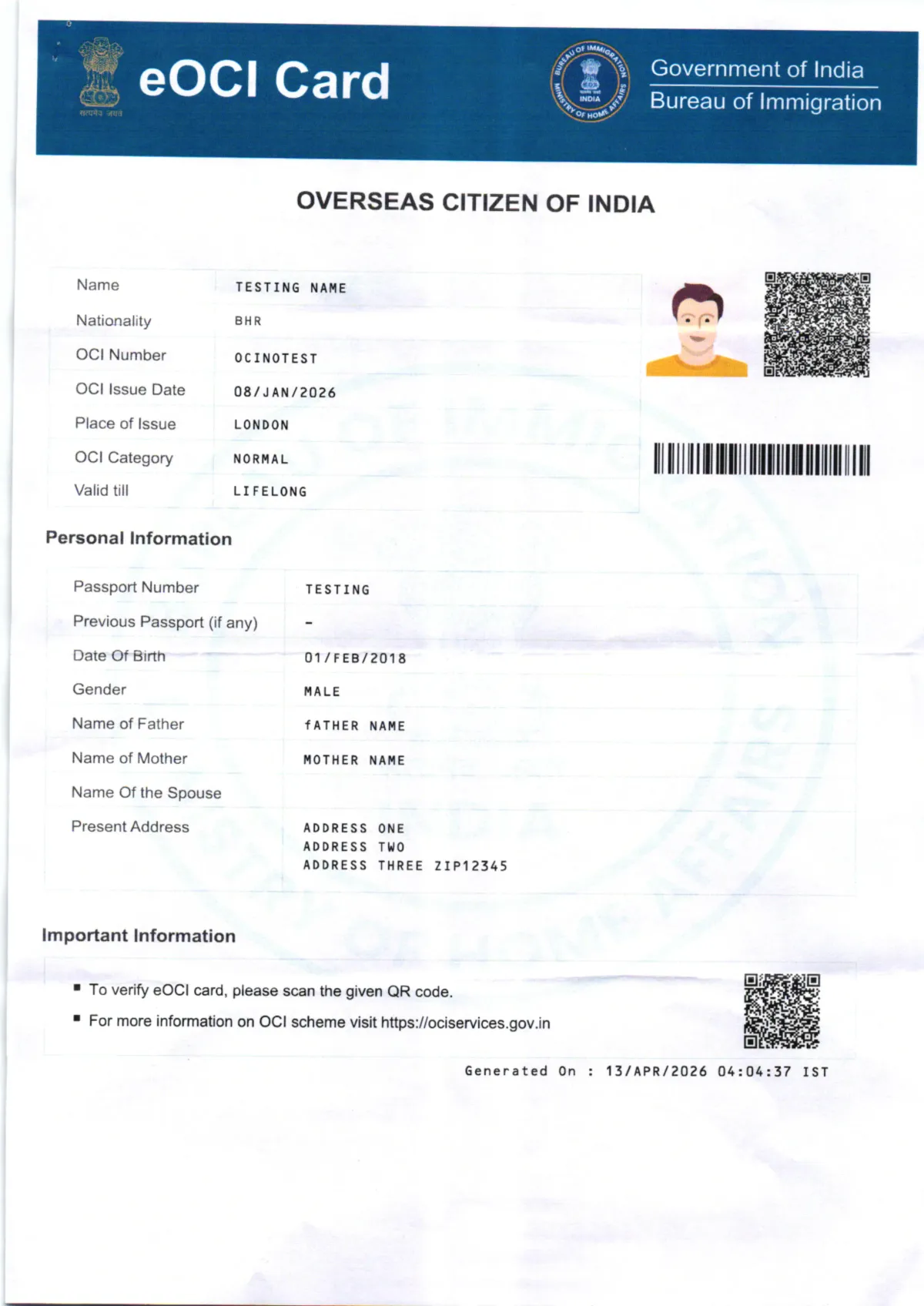
The e-OCI can be downloaded through the official portal or the Indian Visa Su-Swagatam app and saved on a smartphone. It can be presented digitally alongside the holder’s valid passport. Existing physical OCI booklets remain valid. [8, 23]
How the Scheme Evolved
The earlier Person of Indian Origin, or PIO, card scheme began in 1999. It recognised the wish of overseas families to retain practical links with India. [4]
OCI developed against a wider debate about dual citizenship. The Ministry of External Affairs records that the scheme was introduced through an amendment to the Citizenship Act in August 2005, following persistent requests from the Indian diaspora. It was launched at the Pravasi Bharatiya Divas convention in Hyderabad in 2006. Its name reflected those aspirations, but the resulting status did not confer full Indian citizenship. [5]
On 9 January 2015, the government merged the PIO and OCI schemes and stopped issuing new PIO cards. [6] That history explains why older embassy pages and family records may still refer to both documents. A historical PIO card should not be assumed to meet today’s application or travel requirements. The Embassy of India in Bogotá’s current fee schedule directs PIO holders seeking OCI registration after 31 December 2025 to apply under the fresh-registration rules. [7]
The latest major change is digital. According to the Embassy of India in Bogotá, e-OCI launched on 30 June 2026. New OCI documents are now issued electronically, while existing physical booklets remain valid. Holders can download their electronic card through the official OCI portal. [8]
Who is eligible?
OCI is available to foreign nationals who meet a qualifying Indian connection. The main routes cover people who:
- Were Indian citizens on or at any time after 26 January 1950.
- Were eligible to become Indian citizens on 26 January 1950.
- Belonged to a territory that became part of India after 15 August 1947.
- Are children, grandchildren, or great-grandchildren of a qualifying person.
- Are qualifying minor children, including foreign-national minors with one or both parents holding Indian citizenship.
- Are foreign spouses of Indian citizens or registered OCI holders, where the marriage is registered and has continued for at least two years immediately before the application. [9]
The spouse route does not require the applicant to have Indian ancestry. It does require the qualifying marriage and the supporting evidence. Spouse applications undergo security clearance. [2]
Eligibility is subject to exclusions. A person cannot qualify if they, a parent, a grandparent, or a great-grandparent are or have been citizens of Pakistan, Bangladesh, or another country subsequently specified by the government. [9] Foreign military and police service can also prevent registration, although limited exceptions exist for certain compulsory service. [2]
Country-specific exceptions extend eligibility beyond great-grandchildren for some diaspora communities. Check these with the mission. [3]
The practical lesson is simple: family heritage must be supported by a qualifying legal connection and a documentary chain.
What Happens After Divorce
A foreign national cannot obtain OCI solely because they were formerly married to an Indian citizen or an OCI holder. The spouse route requires a qualifying marriage that is still subsisting and has continued for at least two years immediately before the application. Someone who qualifies independently through their own Indian origin may still apply on that separate basis. [3]
For someone who already holds OCI through the spouse route, divorce affects the basis of registration. Section 7D(f) of the Citizenship Act permits cancellation when the qualifying marriage is dissolved. The Embassy of India in Bogotá requires an undertaking to surrender a spouse-based OCI following divorce or separation. The holder should notify the responsible mission promptly and follow its surrender instructions. A person whose OCI was obtained through their own Indian origin is in a different position: divorce does not by itself remove that ancestry-based qualification. [11, 27]
Children have their own connection to the Indian parent. Their parents’ divorce does not by itself remove that connection or their potential eligibility for OCI. Each foreign-national child must nevertheless meet the eligibility rules and have an individual application; registration is not automatic. For minors, divorce and custody documents may be required. A child who is already an Indian citizen does not need OCI. [3]
What documents must be submitted and why?
The exact checklist depends on the application category and the mission handling it. A former Indian citizen, a foreign-born grandchild, and a foreign spouse will not necessarily submit the same papers.
The following is a preparation guide. The relevant mission’s current checklist remains essential.
| Evidence | What Applicants Should Prepare | What It Establishes |
|---|---|---|
| Present citizenship | A valid foreign passport, normally with at least six months’ validity, and a naturalisation or citizenship record where applicable | Identity and current nationality |
| Indian connection | An old Indian passport or accepted evidence of Indian origin, such as a competent authority’s nativity or domicile certificate | The qualifying connection to India |
| Family relationship | Birth certificates and other records linking each generation | The connection between the applicant and the qualifying ancestor |
| Former Indian citizenship | The surrendered or cancelled Indian passport and surrender or renunciation evidence, as applicable | The record of the change from Indian to foreign nationality |
| Residence | An accepted address document and any required evidence of lawful residence | The address and application jurisdiction |
| Identity images | A recent photograph and signature or thumb impression in the required format | Identification and completion of the application |
| Changes in family circumstances | Marriage, divorce, custody, death, or name-change records, where relevant | An explanation of differences between the application and earlier records |
These categories are drawn from official consular checklists. Employment or student-status evidence may also be requested. [2, 10]
Must an expired Indian passport be surrendered?
Yes. Passport expiry and passport surrender are different. Expiry ends the document’s validity for travel. It neither records its surrender nor determines whether its holder remains an Indian citizen. The government’s Passport Seva guidance expressly allows an expired latest Indian passport to be surrendered. [26]
Under section 9 of the Citizenship Act, an Indian citizen who voluntarily acquires another country’s citizenship generally ceases to be an Indian citizen on acquiring it. The Embassy of India in Bogotá explains that a person in this position needs to surrender their Indian passport and obtain the surrender certificate for an OCI application. Formal renunciation under section 8 is a separate procedure for someone who is still an Indian citizen; the embassy says that procedure is not applicable to people who already hold foreign citizenship. Applicants should therefore avoid assuming that they must pay for both procedures. [25, 27]
For former Indian passport holders, prepare the latest Indian passport, proof of the foreign citizenship and its acquisition date, and the surrender evidence required by the responsible mission. If the passport is lost or was surrendered many years ago, check the accepted alternative evidence. Requirements can depend on the date of naturalisation: for example, the High Commission of India in London publishes a notarised-affidavit alternative for certain applicants who acquired foreign nationality before 1 June 2010. This is a documentary exception, not a general exemption because a passport has expired. [24, 25]
Why the Family Chain Matters
An Indian grandparent’s passport establishes something about the grandparent. The application must also establish that the applicant is that person’s grandchild. Birth certificates provide the links between generations. Marriage and name-change records can explain why surnames differ. [24]
This is why assembling the family chain before starting the form is sensible. As a practical preparation step, compare names, dates, and places across the documents. Identify discrepancies early and ask the mission what evidence it will accept to resolve them.
Additional Papers for Children and Spouses
For a minor, prepare the child’s birth certificate, the parents’ identity and nationality records, and the required parental signatures or consent. Custody papers may be necessary where parents are divorced. The Embassy of India in Bogotá also lists the parents’ marriage certificate among its requirements for minors. [11, 24]
A foreign spouse needs the registered marriage certificate and the Indian spouse’s passport, or the OCI spouse’s passport and OCI evidence. The current guidance also calls for the foreign spouse’s apostilled birth certificate and government-issued identity evidence concerning their parents, grandparents, or great-grandparents. The High Commission of India in London’s circular explains that the family records are intended to confirm origin. [12]
The relationship is the basis of this application. The papers therefore establish both the marriage and the applicant’s identity and family background. A spouse-based interview is part of the process; the High Commission of India in London requires the applicant and spouse to attend the interview together. [13]
Why an Apostille is Required
An apostille allows a public document issued in one country to be authenticated for use in another. It confirms the origin of the document, including the relevant signature or seal and the capacity of the official who signed it. It does not certify that everything stated in the document is true. [14]
Where the Hague Apostille Convention applies between the issuing country and India, an appropriately apostilled document generally does not require further consular legalisation. A different legalisation route applies where the Convention does not operate between the countries concerned. [15]
Documents issued abroad must be authenticated through the appropriate authorities in their country of issue. For Colombian documents in Spanish, follow the Embassy of India in Bogotá’s instructions concerning English translations and the apostilling of the translated documents. A translation makes the text readable; authentication establishes its official origin. These serve different purposes. [11, 16]
Can you apply through every Indian embassy?
You should apply through the Indian mission or consulate responsible for your country of citizenship or, when living elsewhere, your ordinary residence. An overseas holiday does not automatically give you the right to submit an application through the embassy at that destination. The central guidance generally uses six months’ continuous residence for a third-country application, with a stated exception for certain children up to age 12. [3]
Nor does every embassy necessarily deliver the service locally. The Embassy of India in Bogotá’s current notice says that it continues to handle OCI and other consular services for Ecuador, even though the Embassy of India in Quito has been functioning since September 2025. The designated processing mission matters more than the mere presence of an embassy. [17]
Some countries use an authorised application centre. The Embassy of India in Washington directs applicants through VFS. [18] Eligible applicants already resident in India may use the appropriate Foreigners Regional Registration Office, subject to the applicable residence and visa conditions. A tourist visa is not an appropriate route for an OCI application within India. [1]
How does the application work?
Start at the official government website, ociservices.gov.in. Complete the relevant application category, upload the required documents and images, and retain the application reference. Follow the responsible mission’s instructions for verification, appointments, payment, and any application-centre submission. [10, 13]
An online application is only part of the procedure. Local arrangements can include verification of original documents, biometric capture, or an interview. Since 1 June 2026, the Embassy of India in Bogotá has generally required prior appointments and personal attendance for visa and OCI submissions. [17]
The Embassy of India in Bogotá’s current overview exempts applicants below 12 and above 70 from biometric capture. Courier submission for exempt applicants requires advance email confirmation, and the embassy can still request personal attendance. [19]
Older checklists can remain online alongside newer notices. Confirm the current appointment and submission arrangements before travelling to the embassy or sending a passport.
How long does it take?
There is no single worldwide delivery promise.
| Official Guidance | Published Indication |
|---|---|
| Central OCI FAQ | About 30 days from online acknowledgement |
| High Commission of India in London: Indian-origin or lineage application | Around five to six weeks |
| High Commission of India in London: foreign-spouse application | Around ten to twelve weeks |
| Consulate General of India in Atlanta: new application based on Indian origin | Normally five to six weeks from consular registration |
These are processing indications, subject to approval and the application being in order. [3, 13, 20]
Preparation time comes before processing time. Obtaining family records, arranging authentication, translating documents, and securing appointments can extend the overall journey. Allow for those stages when planning.
The Consulate General of India in Atlanta explicitly states that OCI applications cannot be expedited or processed on an emergency basis. Where urgent travel is necessary, it advises applying for the appropriate visa while the OCI application continues. [20]
What is the total cost?
The base fee abroad is US$275 or its local-currency equivalent, before additional charges. [3]
Official published examples illustrate the difference:
| Application Location | Published Application Charge or Subtotal | Additional Costs to Consider |
|---|---|---|
| Colombia, through the Embassy of India in Bogotá | COP1,035,000 for a fresh application | Authentication, translations, photographs, travel, and any necessary return of physical documents |
| Ecuador, through the Embassy of India in Bogotá | US$278 for a fresh application | Document preparation, travel where required, and applicable return charges |
| United States, through VFS | US$297 published subtotal: US$275 application fee + US$3 welfare levy + US$19 VFS fee | Applicable delivery, optional services, and document preparation |
The Colombia and Ecuador amounts come from the Embassy of India in Bogotá’s schedule effective 1 April 2026. The US breakdown is published by the Embassy of India in Washington. These are local published charges, not exchange-rate conversions calculated for this article. [7, 18]
The Embassy of India in Bogotá separately lists COP22,000 to return one or two passports within Colombia, and US$55 for the corresponding Colombia-to-Ecuador shipment. These charges concern physical documents when return delivery is needed. An e-OCI card itself is downloaded. [7, 8]
For example, one Colombian application at COP1,035,000 plus the listed COP22,000 return service would come to COP1,057,000, before document preparation or travel. If no return service is required, that addition does not apply.
Former Indian citizens may also incur separate passport-surrender costs. A formal citizenship-renunciation fee applies only where that separate procedure is appropriate. The sensible budget is therefore the mission’s application charge, plus all document, service, and attendance costs applicable to that person. [10]
The central FAQ states that fees are non-refundable if registration or reissuance is rejected. [3]
Is it a one-time cost?
OCI does not carry an annual subscription fee. However, describing it as one payment with no further responsibilities would be misleading.
The current central miscellaneous-services FAQ requires passport details to be updated every time a new passport is issued, regardless of age. It describes miscellaneous services as free, with a US$25 charge for passport updates submitted more than three months after receipt of the new passport. [21]
At the date of this article, the OCI portal announces that this delayed-update penalty is waived until 31 December 2026. That is a temporary waiver. It should not be read as permanent removal of the update requirement. [22]
Spouse-based holders must also provide the prescribed confirmation that their marriage continues when updating passport details. [21]
There is a transition issue worth checking before paying for an existing card. Some local schedules, including the Embassy of India in Bogotá’s April 2026 table, still list charges for replacement physical cards and the age-20 reissuance process. The newer central guidance describes electronic records and free miscellaneous services. Where those instructions differ, ask the responsible mission which procedure and charge apply to your case. [7, 21]
Downloading an e-OCI is free. Losing access to a saved digital copy does not by itself mean paying for a replacement physical booklet: the electronic card can be downloaded again through the official portal. [23]
A Connection Worth Preparing For
For an eligible person who returns to India regularly, OCI can make family visits and longer stays easier to arrange. Its value reaches beyond the first journey. It can help keep a place in everyday life for a country that remains close to the heart.
The best starting point is a clear application route, a complete family record, and the current instructions from the responsible mission. Prepare those well, and the form becomes easier to understand. Each document has a job to do. Together, they tell the story on which the application rests.
Family members who do not qualify for OCI usually need a visa to visit India. Our study The Rising Cost of Travel Visas compares what tourist and business visas for India and seven other destinations cost.
Official Sources
All sources were consulted on 17 November 2026. This guide uses Indian government, embassy, high commission, and consular sources. Where older local instructions differ from current central guidance, the difference is identified above. Fees, submission arrangements, and rules should be checked again before applying.
- Ministry of Home Affairs: OCI introduction, benefits, and application advisory.
- Embassy of India, Buenos Aires: OCI FAQ—legal status, documents, and eligibility restrictions.
- Ministry of Home Affairs: current OCI FAQ—eligibility, spouse validity, jurisdiction, fees, and processing.
- Ministry of External Affairs: Annual Report 2020–21—PIO and OCI history.
- Ministry of External Affairs: Overseas Citizenship of India Scheme.
- Government of India: merger of PIO and OCI schemes.
- Embassy of India, Bogotá: OCI fee schedule effective 1 April 2026.
- Embassy of India, Bogotá: launch of e-OCI cards, notice dated 23 July 2026.
- Embassy of India, Buenos Aires: how to apply—eligibility categories.
- Consulate General of India, Seattle: OCI application and supporting documents.
- Embassy of India, Bogotá: fresh OCI application and document instructions.
- High Commission of India, London: recent OCI circulars—foreign-spouse supporting documents.
- High Commission of India, London: current application procedure and processing indications.
- Government of India, e-Sanad: effects and limits of an apostille.
- Ministry of External Affairs: attestation and apostille guidance.
- Embassy of India, Bogotá: apostille guidance.
- Embassy of India, Bogotá: personal attendance, biometrics, and continued handling of Ecuador applications.
- Embassy of India, Washington: OCI submission arrangements and fee breakdown.
- Embassy of India, Bogotá: current visa and OCI attendance arrangements and age exemptions.
- Consulate General of India, Atlanta: OCI processing times and urgent travel.
- Ministry of Home Affairs: current OCI miscellaneous-services FAQ.
- Official OCI portal: delayed passport-update penalty waiver notice.
- Ministry of Home Affairs: e-OCI FAQ.
- High Commission of India, London: document checklist, lineage records, and minor applications.
- Embassy of India, Bogotá: surrender certificate and distinction from formal citizenship renunciation.
- Passport Seva, Ministry of External Affairs: surrender FAQ, including expired passports.
- Citizenship Act 1955: sections 7A, 7D, 8, and 9 on eligibility, cancellation, renunciation, and acquisition of foreign citizenship.